ArticleResearchTesting

Cold weather, first frosts and football: why not all turf is the same

Across much of Europe the first meaningful frosts of the season have arrived just as the football calendar moves into a critical period of league fixtures and heavy training loads. At this time of year, having surfaces that stay safe and playable in all conditions is essential for equity and access to the game. However, turf is not one single material, and different systems respond very differently to cold and wet weather.

Polymer based systems and stability in the cold

Traditional rubber filled systems use SBR performance infill combined with typically PE fibres. Both are hydrophobic polymers with very low glass transition temperatures, well below -40°C. This means they remain flexible and elastic at typical winter field temperatures. The rubber granules continue to move and deform under load, maintaining shock absorption, traction, etc.… even when air and surface temperatures drop below freezing.

PurePT, a fibre based and non-filled system, behaves in a similar way. Its structure is defined by densely packed fibres. The polymer remains elastic and does not bind water, so the surface response stays the same when hot or cold.

Mineral infill systems and when sand starts to lock

Sand or mineral infilled systems behave very differently. The infill is made up of hard, angular mineral particles with pore spaces that retain moisture between the grains. As temperature falls and the surface becomes cold and wet, several things happen at the same time:

  • Water between sand grains becomes more viscous and then begins to freeze
  • Thin water or ice films and capillary bridges form between particles, which increases inter particle cohesion and friction
  • The sand changes from a free-flowing granular material into a much stiffer, partially locked matrix (this is how we make sandcastles!)

The result is a surface that deforms less under load and absorbs less impact. In practical terms, mineral infill systems which sit comfortably inside preferred norms at warm temperatures can quickly move outside the safe or preferred ranges as they become cold. Surface hardness increases, shock absorption is reduced and the traction or grip significantly drops.

Polymer biased systems, in contrast, remain within target windows over the same temperature change because their elastic response is not governed by changing conditions.

Change in SA (%) with temperature
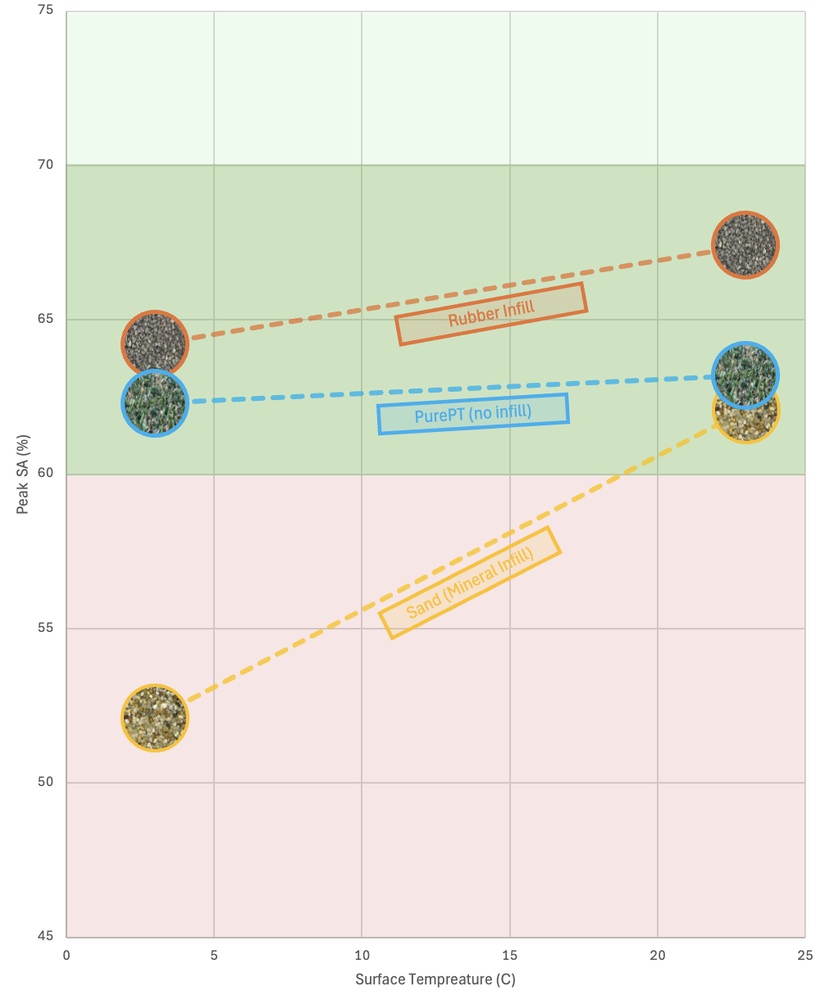
In the graphs this is very clear. From 23°C down to 3°C the performance curve for the sand or mineral system drops away from the green (FIFA) range of preferred values from both grip and shock absorption, while rubber filled and Pure PT systems remain stable.
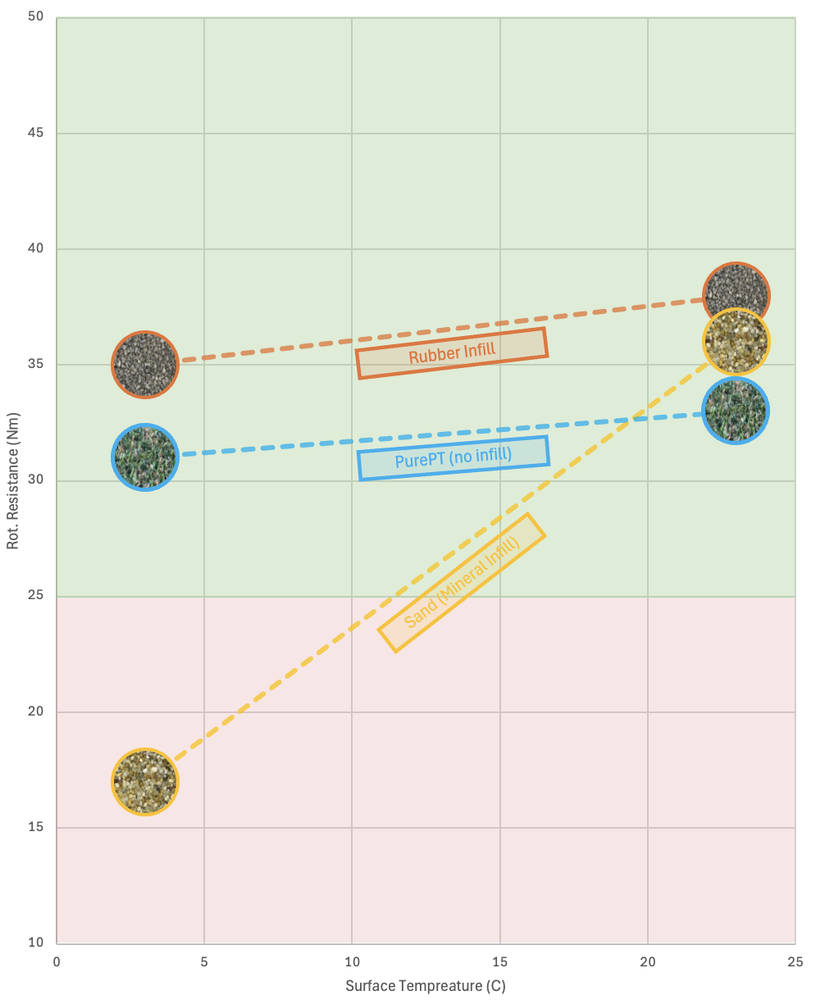
This is a useful reminder that if we care about equal access to safe football throughout the cold winter months, we must design and test our surfaces for real world conditions.
 

Related Articles

Turf innovation
Article

From Mud to Mastery: The Transformation of Natural Grass Pitches


Over the past 30 years, natural grass football fields have undergone one of the most remarkable transformations in modern sport. In the 1980s and 1990s, even top-level stadiums regularly featured surfaces that were muddy, inconsistent, and unpredictable. Matches were often shaped as much by divots and ruts as by tactics and skill. It was common to see standing water in goalmouths, bare patches across midfield, and players sliding through thick mud.…
Read more
Article

Enhancing Urban Health Through Green Spaces


In densely populated urban environments access to play, sport and recreational spaces is not merely an aesthetic enhancement but a critical component of public health. Research consistently demonstrates that outdoor environments contribute to reduced stress levels, improved mood, and enhanced physical well-being. Turf surfaces in particular offer a sustainable and accessible solution to the scarcity of green spaces in urban areas. By providing safe, inviting, and functional outdoor environments, turf surfaces…
Read more
Drainage artificial Turf
Article

Artificial Turf & Drainage: Debunking the Myths


I’m often asked how turf handles water. A surprising number of people still believe turf is impervious to water. This is simply not true Turf is engineered to drain water rapidly, often far exceeding the performance of natural grass or typical backyard surfaces. Most turf systems drain at tested and certified rates of hundreds of inches (thousands of mm) per hour. 🔍 Key Facts: 1.     Exceptional Drainage Rates Turf systems have…
Read more
Research

Predictability: The Foundation for ALL Sports Surfaces


When athletes step onto a field, whether they are elite professionals or grassroots players, they expect one thing above all else: trust in the surface beneath them. Different sports require specific surface characteristics such as defined traction, ball properties, and shock absorption. Yet across all ages, abilities, and disciplines, one factor consistently emerges as essential for both performance and safety: predictability. Extensive biomechanical research and independent player studies have demonstrated that the…
Read more
Infill splash
Article

The Rooster Tail! Spray of black rubber.


It may look dramatic in slow motion replays, a spray of black rubber erupting behind a tackle or a hard hit ball. But the “rooster tail” is not something we want to see from a well designed turf system. When there is too much infill in the turf system, the material becomes highly mobile. That leads to: Inconsistencies across the field as infill migrates from one area to another Uneven playing…
Read more
Grip traction in turf
ResearchTesting

Grip, Traction, & Cleat Release


In our latest round of player testing, we’ve taken a deep dive into the biomechanics of cleat release, often simply thought of as grip or friction, between the athlete and the surface. Using a suite of high-end sensors, IMUs, and high-speed video analysis, we’ve measured cleat release down to the millimeter. We worked with a diverse group of players (N = 300); male and female, elite and amateur, and tested under…
Read more